


Like other regulatory frameworks, controlled substance compliance continues to evolve in response to changes in healthcare and public safety. These shifts impact every part of the controlled substance supply chain, including manufacturers, wholesalers, pharmacies, and the patients they serve. As a result, each year brings new compliance developments that directly and indirectly shape pharmacy workflows. This raises an important question: how can pharmacists not only keep up with these changes, but also adapt their already demanding operations to meet them?
This post offers a broad pharmacy outlook for 2026, highlighting key regulatory updates such as changes to the CSA, the rollout of DSCSA enforcement for smaller dispensers, and upcoming HIPAA requirements. It also explores emerging trends and practical strategies to help pharmacies stay compliant and prepared for the year ahead. With thoughtful planning and the right tools, pharmacies can navigate these changes with confidence while maintaining a safe, efficient, and compliant environment for both patients and staff.
CSA Compliance
Since 1970, the Controlled Substances Act (CSA) has been enforced at the federal level by the Drug Enforcement Administration (DEA) to regulate the manufacturing, distribution, importation, exportation, and use of controlled substances. As part of the pharmacy outlook for 2026, several key updates are expected that will impact controlled substance compliance.
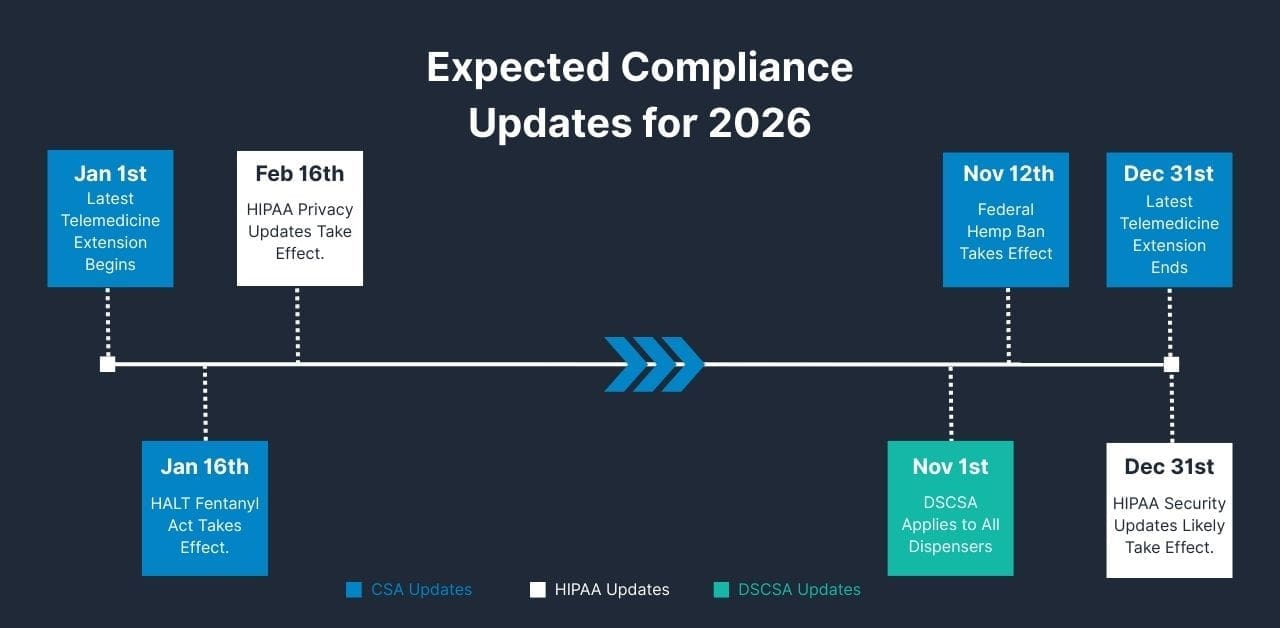
- Prescribing Controlled Substances Via Telemedicine: Originally introduced as a temporary measure during the COVID-19 pandemic, the allowance for practitioners to prescribe controlled substances (schedules II-V) via telemedicine without an initial in-person examination has been extended multiple times. On December 31, 2025, the DEA officially announced a “Fourth Temporary Extension” of these flexibilities through December 31, 2026.
- HALT Fentanyl Act Takes Effect: Beginning January 16, this act will permanently place all fentanyl-related substances into Schedule I of the CSA. Graff & McGovern note that this change will require pharmacists to adjust procedures to meet stricter DEA requirements for dispensing and reporting.
- Federal Hemp Ban Comes into Play: Effective November 12 under the Continuing Appropriations, Agriculture, Legislative Branch, Military Construction and Veterans Affairs, and Extensions Act, 2026 (H.R. 5371), the legal definition of hemp will change to measure total THC concentration on a dry weight basis. Any product exceeding 0.3 percent total THC or containing more than 0.4 mg per container will be considered illegal. Pharmacies dispensing or selling over-the-counter THC products that do not meet these standards will need to update their practices.
Pharmacists should also monitor federal and state schedule changes for other substances. Gabapentin, for example, is classified as a Schedule V controlled substance in several states, with additional states imposing reporting requirements. While the CSA forms the foundation of controlled substance compliance, other legislation, such as DSCSA, will also affect the pharmacy outlook in 2026.
DSCSA Compliance
First enacted in 2013, the Drug Supply Chain Security Act (DSCSA) will apply to all dispensers by November 2026. Its purpose is to establish a secure system that traces prescription drugs from manufacturers to patients, minimizing the risk of counterfeit or illegitimate medications entering the supply chain.
In 2025, these requirements went into effect for manufacturers, repackaging firms, wholesalers, and larger dispensers with more than 25 pharmacists and technicians. Smaller dispensers will come under full enforcement approximately one year later. Key responsibilities include maintaining accessible transaction data for six years, responding to regulatory inquiries, and implementing Standard Operating Procedures for identifying and managing suspicious activity.
While DSCSA overlaps with some CSA obligations, it applies to the entire prescription drug supply chain rather than only controlled substances. Pharmacies should review how DSCSA requirements integrate with existing workflows and begin preparing well in advance of November 2026.
For more information on CSA and DSCSA requirements, explore our detailed blog here.
HIPAA Compliance
The Health Insurance Portability and Accountability Act (HIPAA) has been in place since 1996. Initially created to improve the portability and accountability of health insurance, HIPAA has expanded to establish privacy and security rules protecting personal health information. Maintaining HIPAA compliance is critical for pharmacists and healthcare professionals to safeguard sensitive patient information, including data relating to controlled substance compliance.
In 2026, two major updates are expected to impact the pharmacy outlook:
- Privacy Rule Updates: HIPAA will introduce stricter limits on sharing patient data related to reproductive health and substance use treatment. Effective February 16, covered entities and business associates will be prohibited from using or disclosing protected health information for the purpose of investigating or imposing liability for lawful reproductive care.
- Security Rule Updates: Between late 2026 and early 2027, HIPAA’s security standards will be modernized with new cybersecurity requirements. These include multi-factor authentication, encryption of electronic protected health information, and faster breach reporting by third-party business associates. These updates aim to strengthen protection for digital health information and reduce security risks.
Other Contributors to the Pharmacy Outlook
Not all controlled substance compliance changes for the 2026 pharmacy outlook are fully defined. Regulatory frameworks and technology continue to evolve rapidly, making scalability and adaptability crucial for pharmacy operations.
- Artificial Intelligence Regulation: AI tools handling controlled substance compliance data will likely face new regulatory expectations around transparency, clinical-grade standards, and HIPAA compliance. Some states, especially in the western United States, have already implemented AI-specific regulations focused on data privacy and disclosure.
- Electronic Prescribing of Controlled Substances (EPCS): As HIPAA and CSA/DSCSA rules modernize, EPCS is expected to become mandatory nationwide to enhance safety and prescription traceability. Federal enforcement for long-term care providers is scheduled for 2028, but many states already require EPCS in some capacity.
- Annual Regulatory Updates: Pharmacies should continue monitoring changes such as aggregate production quotas for Schedule I and II substances, which affect medication availability based on projected legitimate demand. CSA violation fines are also adjusted annually for inflation, growing at a compound annual rate of approximately 3.27 percent.
Remaining aware of the pharmacy outlook helps pharmacies prepare for compliance challenges and ensures smoother operations in 2026.
Staying On Top of Controlled Substance Compliance
Staying informed and taking proactive action on the latest controlled substance compliance requirements is essential for a safe and well-organized pharmacy. Trusted resources such as the Federal Register, state board websites, and professional DEA training can help pharmacists get a good idea of the upcoming pharmacy outlook. Even with these resources, balancing regulatory demands with daily operations can be challenging, which makes workflow updates and adaptive tools essential.
C2 Keep is a cloud-based, fully integrated, HIPAA compliant platform designed to help pharmacies manage controlled substance compliance efficiently. With built-in features for CSA and other regulatory requirements, C2 Keep centralizes accountability, documentation, and reporting to simplify compliance for your pharmacy team.
To learn more, schedule a demo with our founder and CEO, Roland Achenjang, PharmD.


Anyway to get on your email list. Pharmacist found this informative. Many Thanks
Hi Sharon, I’m glad this was helpful! You’ve been added to our email list. If you’d like to learn more about C2 Keep, you’re welcome to schedule a demo and invite any colleagues as well.